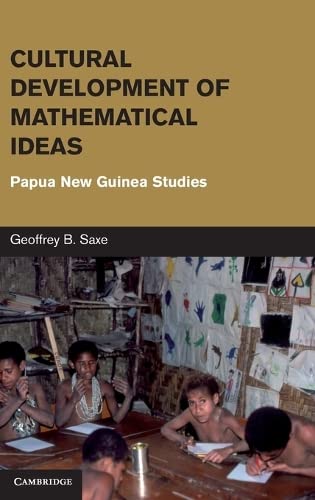
Cultural development of mathematical ideas : Papua New Guinea studies / Geoffrey B. Saxe ; with Indigo Esmonde.
Material type: TextSeries: Learning in doingPublication details: New York : Cambridge University Press, 2012.Description: xxxiii, 362 p. : ill., maps ; 24 cmISBN:
 - 9780521761666 (hardback)
- 0521761662 (hardback)
- BF 311 Sax
| Cover image | Item type | Current library | Home library | Collection | Shelving location | Call number | Materials specified | Vol info | URL | Copy number | Status | Notes | Date due | Barcode | Item holds | Item hold queue priority | Course reserves | |
|---|---|---|---|---|---|---|---|---|---|---|---|---|---|---|---|---|---|---|
 Non-Fiction
|
Kapasa Makasa University Open Access | Kapasa Makasa University | Non-fiction | BF 311 Sax (Browse shelf(Opens below)) | Available | 300612 |
Includes bibliographical references and index.
Machine generated contents note: Introduction; Part I. The Origins of Number-Enduring Questions: 1. Culture-cognition relations; 2. Cultural forms of number representation used in Oksapmin communities; Part II. Economic Exchange: 3. Collective practices of economic exchange: a brief social history; 4. Reproduction and alteration of numerical representations; 5. Reproduction and alteration in currency token representations; 6. Representational forms, functions, collective practices, and fu: a microcosm; Part III. Schooling: 7. A brief history: collective practices of schooling in Oksapmin; 8. Unschooled children's developing uses of the body system; 9. Children's adaptations of the body system in school in 1980: an unintended consequence of post-colonial schooling; 10. About twenty years later: schooling and number; 11. Teachers and students as (unintentional) agents of change; Part IV. Towards an Integrated Treatment of Socio-Historical and Cognitive Developmental Processes: 12. What develops? A focus on form-function relations; 13. How do quantification practices develop?; 14. Why do form-function relations shift?; Epilogue.
"The book presents a general framework for the analysis of culture-cognition relations that makes use of field studies with a remote Papua New Guinea culture group, the Oksapmin, as an illustrative case"-- Provided by publisher.
"Drawing upon field studies conducted in 1978, 1980, and 2001 with a remote Papua New Guinea group, the Oksapmin, Geoffrey Saxe traces the emergence of new forms of numerical representations and ideas in the social history of the community. In traditional life, the Oksapmin used a 27-body-part counting system, and there is no evidence that Oksapmin used arithmetic in prehistory. With shifting practices of economic exchange and schooling, children and adults unwittingly reproduce and alter the system as they solve new kinds of numerical and arithmetical problems, a process that leads to new forms of collective representations in the community. While Saxe,Ŵs focus is on the Oksapmin, the insights and general framework he provides are useful for understanding shifting representational forms and emerging cognitive functions in any human community"-- Provided by publisher.