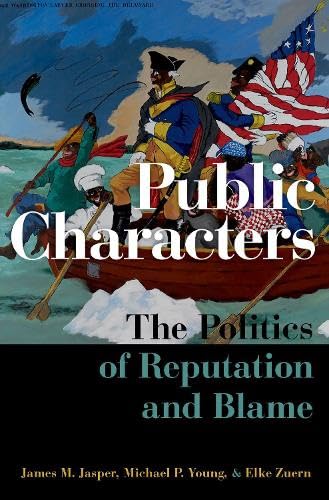
Public characters : the politics of reputation and blame / James M. Jasper, Michael P. Young, and Elke Zuern.
Material type: TextSeries: Oxford studies in culture & politicsPublisher: New York, NY : Oxford University Press, [2020]Description: xiv, 305 pages : illustrations ; 24 cmContent type:
 - text
- unmediated
- volume
- 9780190050047
- 0190050047
- Reputation -- Political aspects
- Blame -- Political aspects
- Character -- Political aspects
- Political sociology
- Blame -- Political aspects
- Political sociology
- Gefühl
- Öffentliche Meinung
- Politik
- Politiker
- Politische Soziologie
- Prestige
- Repräsentation Soziologie
- Schande
- Réputation -- Aspect politique
- Blâme -- Aspect politique
- Caractère -- Aspect politique
- Sociologie politique
- JA 76
| Cover image | Item type | Current library | Home library | Collection | Shelving location | Call number | Materials specified | Vol info | URL | Copy number | Status | Notes | Date due | Barcode | Item holds | Item hold queue priority | Course reserves | |
|---|---|---|---|---|---|---|---|---|---|---|---|---|---|---|---|---|---|---|
 Non-Fiction
|
Kapasa Makasa University Open Access | Kapasa Makasa University | Non-fiction | JA 76 Jas (Browse shelf(Opens below)) | Available | 300678 |
Includes bibliographical references (pages 267-298) and index.
Introduction: politics as character work -- Part I. How we imagine characters -- The art of the word -- Sights and sounds of characters -- The psychology of creating persons -- Arenas of character work -- Part II. The primary characters -- We fear villains -- Ridicule and contempt for minions -- We admire heroes -- We pity victims -- Part III. Variations and transformations -- From victims to heroes -- Beyond characters? -- Conclusion: the politics of blame -- Appendix: unsettling humor.
Heroes, villains, victims, and minions are more important than ever before in our politics and culture. In the era of television, Twitter, and Facebook, groups and individuals constantly battle over their reputations. One of the best ways to gain power is to persuade others that you are competent, courageous, and benevolent, while your opponents are none of these. Thus, character work consists of more than simple claims of fact; societies build their solidarity and policies out of admiration for heroes but also outrage over villains. 0Recent political analysis has ignored the great characters of the past in favor of frames, heuristics, codes, and identities. In Public Characters, James M. Jasper, Michael P. Young, and Elke Zuern argue that character, reputation, and images matter in politics, and social life more generally, as they help mobilize people and their passions. First, they focus on the political construction of openly constructed and debated public characters to show how we can allocate praise and blame, identify social problems, cement identities and allegiances, develop policies, and articulate our moral intuitions through them. The authors demonstrate the nuances of characters and their interactions across a range of sources-including Shakespeare, Game of Thrones, Renaissance sculpture, modern comic books, Alexander the Great, and Bernie Madoff-all the while showing how public characters are used in political rhetoric. Finally, they complicate these characters by considering their transformations: when victims manage to become heroes and the way traditional moral characters have evolved over time to correspond with what different cultures admire, detest, or pity. 0This rich, detailed, and wide-ranging analysis of personal images and reputation marks a timely and crucial contribution for sociologists and political scientists concerned with the cultural dimensions of political life.